
Environmental Law News Update
December 1, 2025
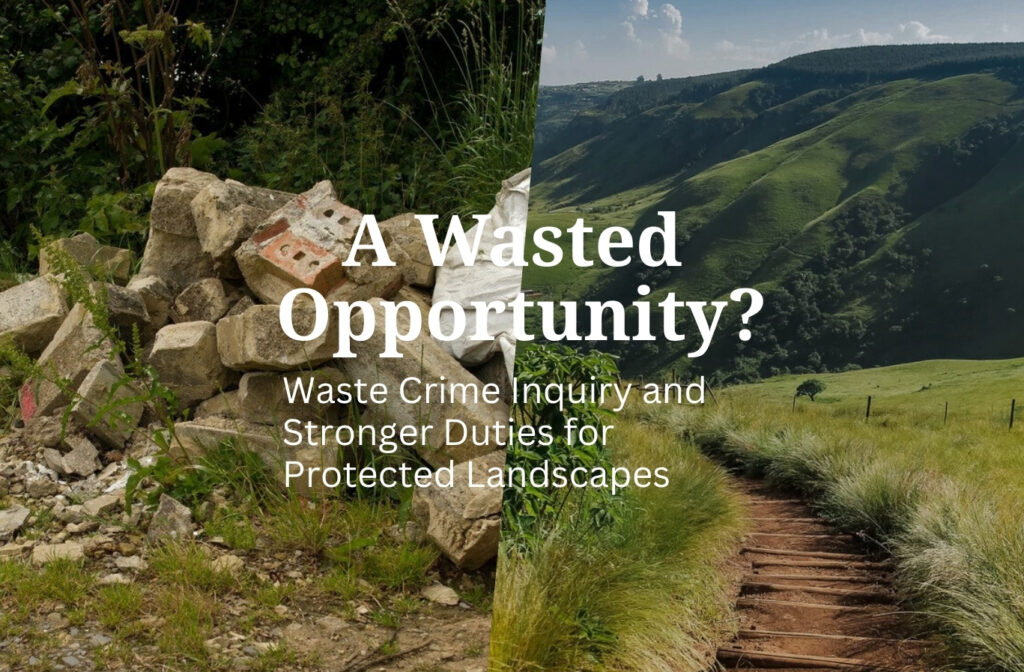
A Wasted Opportunity?
On 28 October 2025, the House of Lords Environment and Climate Change committee wrote to the Secretary of State following a short inquiry in September and October into Serious and Organised Waste Crime.
The letter made, at least, two bold assertions: ‘Regrettably, we have not been able to establish the exact cause(s) of failures to prevent and effectively prosecute waste crime, but it is difficult to conclude that incompetence at the Environment Agency has not been a factor.’
The letter lambasted the Environment Agency for alleged failure to pursue repeated reports of serious waste crime, alleged failure to utilise powers available to it to stop the mass illegal dumping of waste and alleged failure to bring timely and successful prosecutions against perpetrators of serious and organised waste crime.
The letter also criticised the police for showing a ‘lack of interest’ in bringing to bear their expertise in tackling serious and organised waste crime.
The letter did not identify and point to the resources that had been made available for both the Environment Agency and police to accomplish the tasks assigned to them against which their ‘competence’ and ‘interest’ can be measured.
The inquiry evidence itself identified, for example, that the Joint Unit for Waste Crime in the Environment Agency had been given just seven staff to investigate waste crime. The inquiry failed to consider the personnel requirements and length of time required to undertake even a single organised crime investigation, for example a drug importation conspiracy. Such inquiry might have provided a useful bench-mark for their assessment. Such a basic and cursory investigation by the House of Lords committee may have answered at least a small and obvious ‘exact cause’ of failure that they were unable to establish.
There was no proper exploration of investigative and other powers available to Environment Agency officers, and a comparison with those available to the police tasked with investigating organised crime groups.
The cursory inquiry instead relied on unusual contentions from the perspective of anyone that has been involved in directing serious criminal investigations. For example, that the failure to promptly obtain a restriction order at Hoad’s Wood in Kent was a contributory factor in preventing people illegally dumping waste including hazardous waste at the site. The letter does not explain either how a breach of a restriction order which carries a maximum of two-years’ imprisonment was a greater deterrent to those illegally tipping waste than a conviction for fly-tipping that carries up to a five-year sentence. Nor does the letter explore how a restriction notice would make it more likely to identify and apprehend the perpetrators of either offence, including the organisers of the offending, without adequate resources and a full range of investigative and crime prevention powers.
The recommendations called for a ‘root and branch review conducted independently’ of DEFRA and HMRC.
There would be many that work in this sector who would welcome such a review, but perhaps to properly explore the ‘exact cause(s) of failures’ including taking evidence from those with practical experience of investigating and prosecuting organised crime and with a remit to make specific financial recommendations.
If the letter is seen as waving a flag to draw attention to the problem, it may succeed. As a serious review of the issues around addressing waste crime in either the regulated or unregulated sectors it is a wasted opportunity.
Protected Landscapes – The Stronger Duty “seek to further the purpose”
Section 245 of the Levelling-Up and Regeneration Act 2023 amended several statutes concerned with the purposes of conserving and enhancing the natural beauty of National Parks, AONBs and the Broads.
The stronger duty requires that authorities “must seek to further” these statutory purposes rather than “shall have regard” to them – see e.g. s.11A(1A) & s.85(A1) of the Countryside and Rights of Way Act 2000 as amended. Authorities should be more proactive rather than passive.
In the planning context, an authority’s ability to be proactive is likely to be curtailed by the particular terms of the development application before them. However, there might be scope for influencing design or adding planning conditions which mitigate harm to the statutory purposes.
The duty does not require the statutory purposes to be achieved but instead encourages seeking to further them. Also, the purpose of “conserving and enhancing” is to be read as disjunctive rather than conjunctive, so that a decision-maker need only show that they have sought to advance one or other of these aims, not both (see R (Great Trippetts Estate Limited v S/S for CLG [2010] EWHC 1677 (Admin) at 10).
There is therefore no need to be satisfied that the proposed development would enhance natural beauty. The phrase “seek to further” does not, on its face, say anything about enhanced weight. So, as matters stand, the duties do not require enhanced or decisive weight to be given to the statutory objectives. Nor do they treat harm to protected landscapes as a veto on development. Therefore, it is open to decision-makers to balance the statutory purposes with countervailing factors.
If the decision-maker is satisfied that the proposed development will leave the natural beauty, wildlife and cultural heritage of the AONB/protected landscape unharmed, and they have clearly explained this in the appeal decision, they may grant planning permission on the basis that they have thereby discharged the duty – see paragraph 86 of R (New Forest Park Authority) v SSHCLG [2025] EWHC 726 (Admin).
A finding that residual harm to landscapes or AONBs would exist does not automatically mean planning permission should be refused. There may be justified benefits and mitigation measures which would outweigh the harmful effects – if so, these must be clearly and properly weighed against the duties and reasoned in the appeal decision.
There are also two more recent cases to take note of: R (CPRE Kent) v SSHCLG [2025] EWHC 1781 (Admin) and R (Wadhurst PC) v SSHCLG [2025] EWHC 1735 (Admin). The main thrust of the claimants’ arguments being that the duty should be interpreted to mean that harm to an AONB should be treated as requiring refusal of planning permission regardless of the strength of countervailing considerations. Both judgments reaffirm the finding in New Forest that the statutory duty to “seek to further” conservation purposes is more demanding than the old “have regard to” test, but that the new duty is not an absolute prohibition on development.
If the specific characteristics are left unharmed then the decision-maker will have properly sought to further the statutory purpose of conserving and enhancing.