We report on two recent Environment Agency prosecutions for illegal waste crime.
December 24, 2025
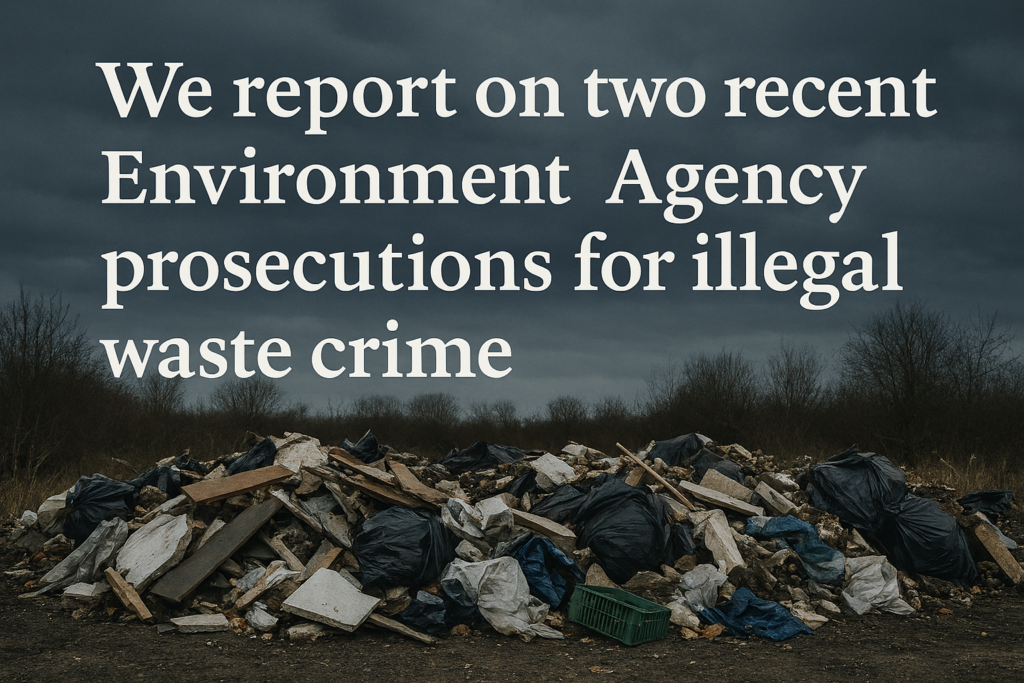
First, a site at Hook Cliff Farm, Gonerby Moor, near Grantham. The site had hazardous motor vehicle waste as well as mixed household and commercial waste, and it is estimated that the site imported some 27,000 tonnes of construction and demolition waste. The illegal activity was caught on camera by drones in 2022 and a court warrant led to an unannounced inspection.
Three individuals and one company were prosecuted for offences contrary to the Environmental Permitting (England and Wales) Regulations 2016 and/or Environmental Protection Act 1990.
- Anthony Critchley admitted running a waste site without the necessary environmental permits and disposing of waste in a manner likely to cause environmental pollution through burning the waste. He received a 6-month prison sentence suspended for 12 months and was ordered to clear the site of all unpermitted waste by 14 August 2026.
- Kaspars Runkauskis admitted operating an unpermitted vehicle breaking business on part of the farm and received a 10-month prison sentence suspended for 18 months.
- Darren Priestley operated Budget Skips Limited and admitted failing to take reasonable measures to prevent unpermitted deposits of waste. He received a conditional discharge for 2 years and a Criminal Behaviour Order.
- Laffeys Ltd admitted making regular deposits of unpermitted construction and demolition waste at the site without compliance with its duty of care. It was fined £3,000 and ordered to pay costs of £1,500.
Enforcement Undertakings (which are available to the Environment Agency as an alternative sanction to prosecution or fine for certain environmental offences) were accepted by three companies and led to donations to environmental charities totalling £98,000. It is noteworthy that multiple methods are being used to detect and prosecute illegal waste crime (such as drone footage which led to this prosecution) and that custodial sentences are being imposed. However, the question remains as to whether individuals and companies will be deterred from committing such crimes or whether the money that can be made from illegal waste crime remains too tempting – by operating without a permit, Mr Critchley avoided permitting fees, taxes, and infrastructure costs of over £500,000.
Second, a site in Cornwall. The site was in Lower Spargo, to the west of Falmouth. Treve Young, the Defendant, was charged with two offences of (i) operating a regulated facility without an environmental permit, and (ii) failing to provide when demanded copies of all written descriptions of waste.
A U1 waste exemption allows businesses such as farmers to use suitable waste for construction projects and maintenance work. There are limits to it: up to a maximum of 1,000 tonnes of soil and stones, and up to 5,000 tonnes of inert material (e.g., bricks, concrete, tiles and ceramics) – and that waste must be used for the purposes of construction. But Mr Young was operating well beyond those limits.
The Environment Agency investigation assessed that over 27,000 tonnes had been imported to the site (the same number as per the Hook Cliff Farm case). Photos showed vast dumping of it on the fields near the Lower Spargo farm.
Mr Young admitted in interview under caution he had deliberately concealed documents from Environment Agency officers to try to cover up the true volume of waste imported. He pleaded guilty to both offences at the first hearing and was sentenced to 2 weeks imprisonment suspended for 18 months, 100 hours unpaid work, a fine of £30,000, prosecution costs of £5,739.82, and a victim surcharge.
Both of these stories are successes at the end of 2025 for the Environment Agency, which has been in the news recently over its response to the vast waste dump on the border of the A34 near Kidlington in Oxfordshire.